VVLLC helps organizations and leaders move from symbolic engagement to governance by identifying the structural, relational, and implementation gaps that limit meaningful participation, decision-making, and systems change.
Real examples of how youth insight, when structured through governance and collaboration, can lead to measurable systems change.Turning Youth Insight into Systems Change
The Virtue Visionary Youth-Led Systems Change Model© was developed through years of designing, implementing, and evaluating youth governance within real organizational systems and cross-system collaboration. Rather than emerging from theory alone, it provides organizations with a practical framework for translating lived experience into governance, decision-making, and systems improvement. Instead of treating youth voice as an isolated initiative, the model demonstrates how insight can move through organizational structures to influence policy, practice, implementation, and accountability.
The examples below illustrate how youth insight can move beyond consultation to shape policy, practice, and operational systems. They reflect initiatives advanced through youth leadership and cross-system collaboration during leadership of the Hamilton County Youth Advisory Board and related partnerships.
These examples are shared for educational purposes to demonstrate the application of youth-led systems change in practice. They do not represent official endorsements by partner organizations.
Youth Governance & Systems Learning in Practice
What Youth Governance Requires in Practice:
Youth are positioned within decision-making structures, not outside of them
Roles, expectations, and accountability are clearly defined for youth and adults
Youth insights directly informs policy, practice, and system improvements
Systems are designed to sustain engagement, not rely on one-time input.
The Pattern Behind the Practice
Across each case study, the same systems change cycle emerged:
1. Youth Insight
Lived experience identified barriers within existing systems.
2. Systems Analysis
Youth leaders and partners examined policies, processes, and structural gaps contributing to the problem.
3. Cross-System Collaboration
Stakeholders across agencies, institutions, and sectors coordinated to address the issue.
4. Structural Change
Systems adopted new processes, resources, or practices that improved outcomes for youth.
This pattern forms the foundation of the Virtue Visionary Youth-Led Systems Change Model ©.
Youth Governance in Practice
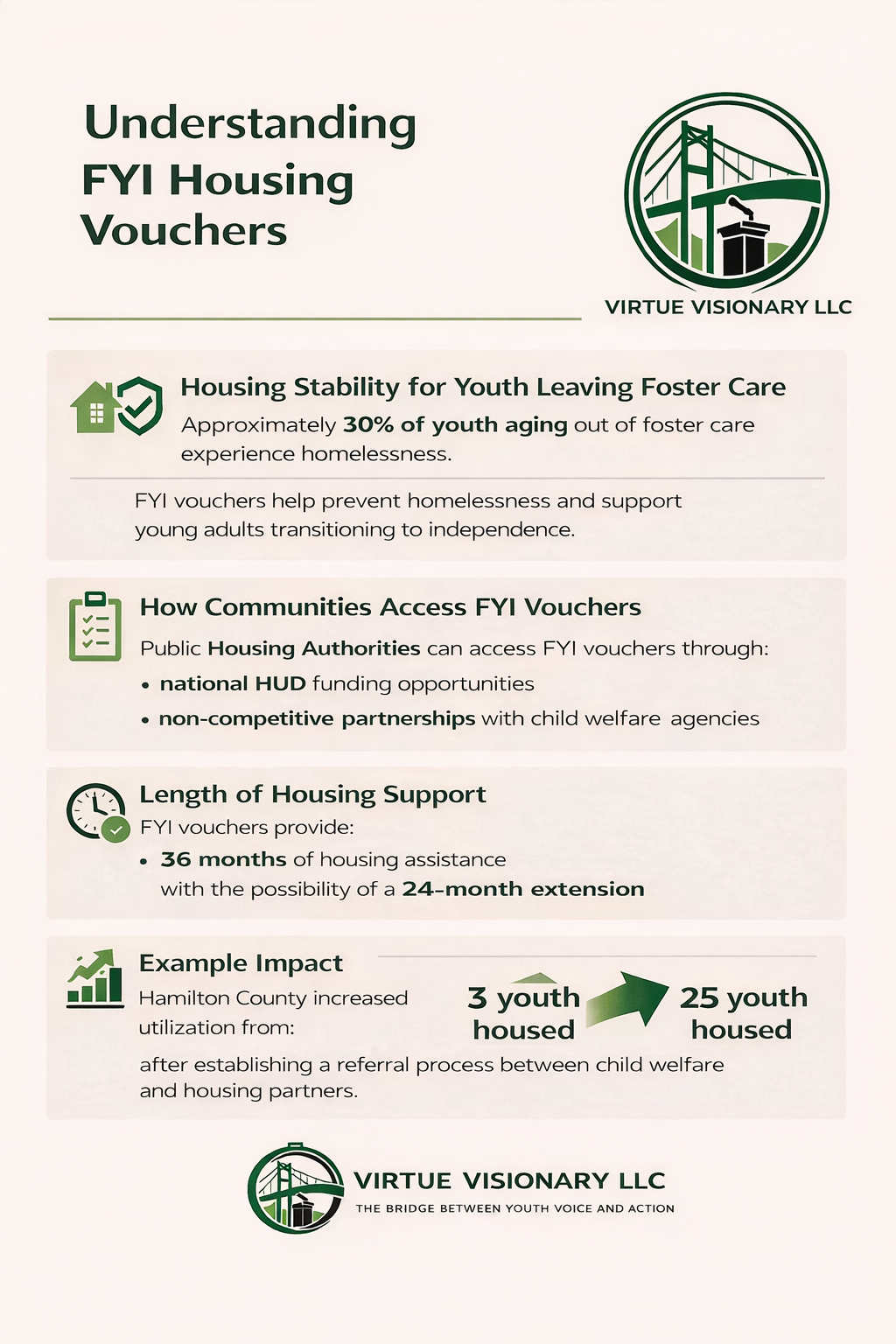
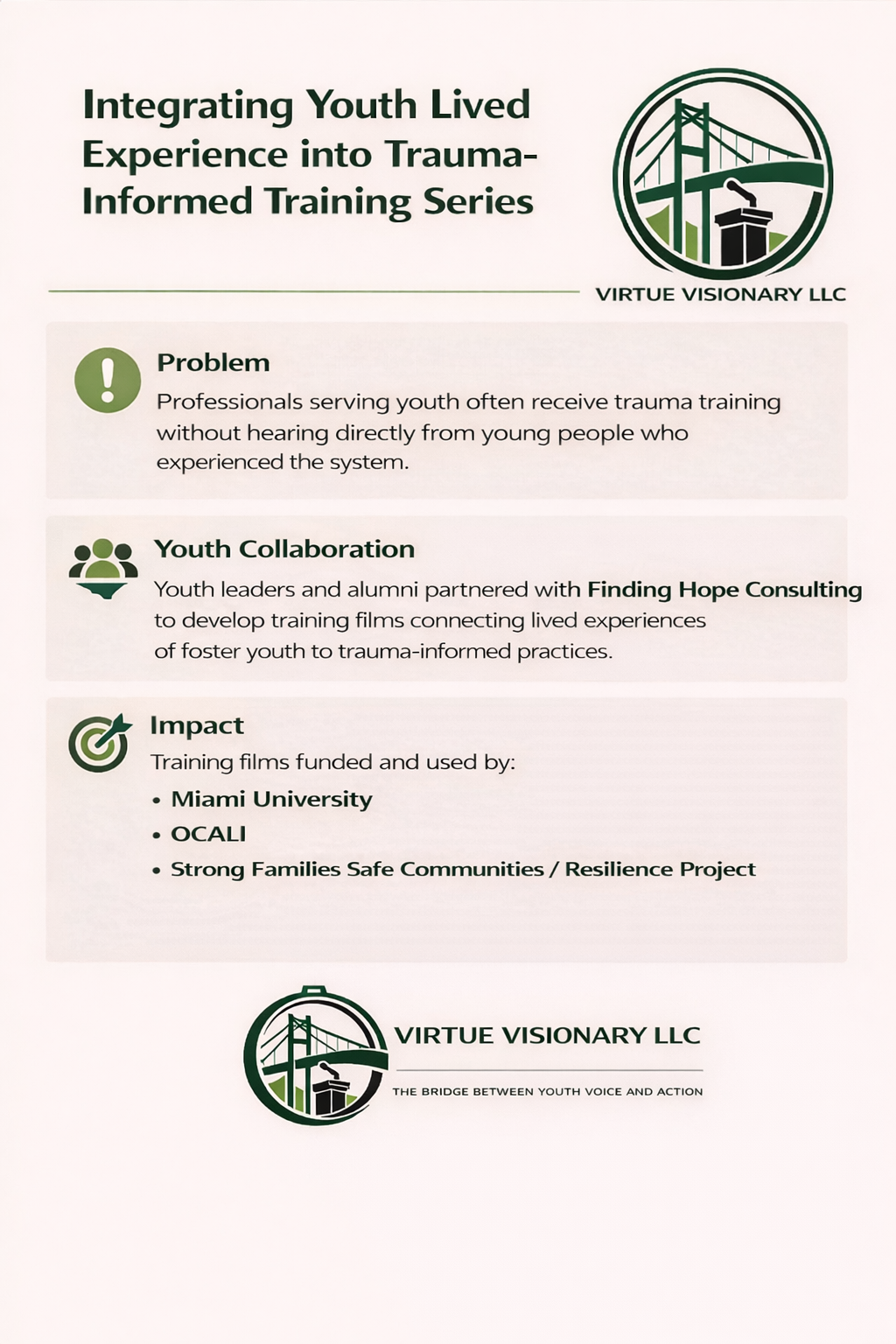
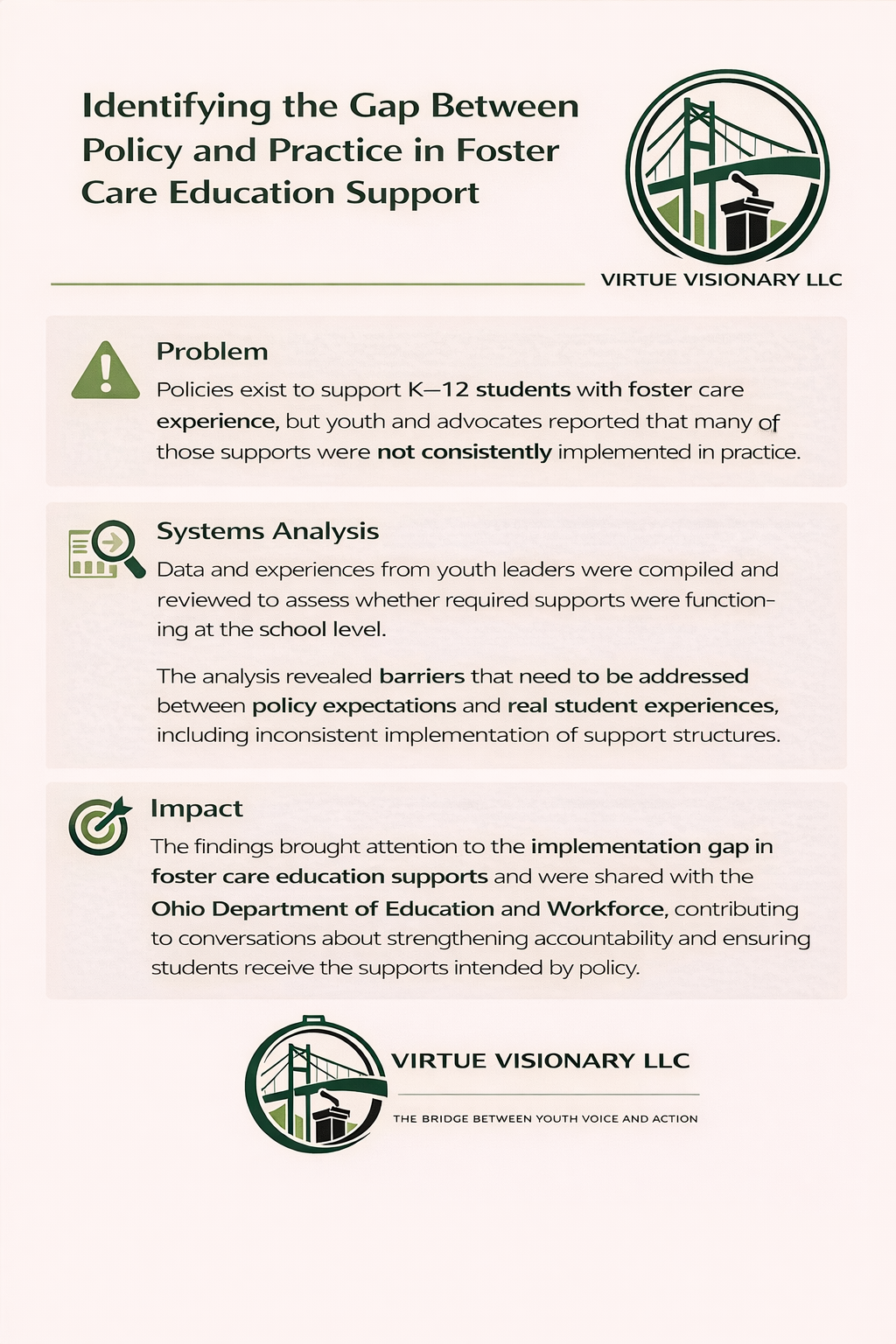
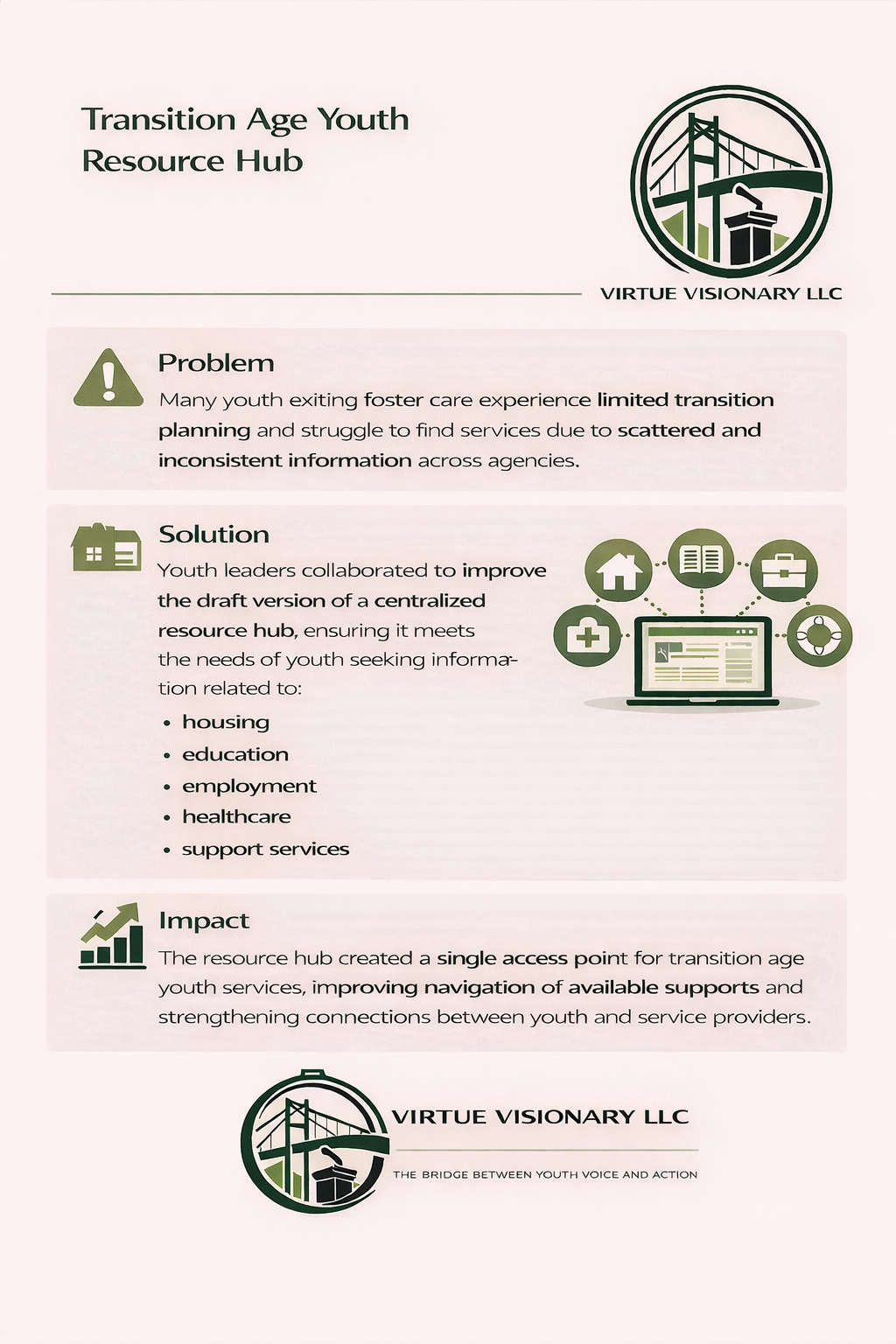
The examples below illustrate how youth insight, when structured through governance and collaboration can influence decision-making, accountability, and system design.
Click each practice example to explore how this work has been applied in practice.
Systems Learning in Practice
Some examples show youth governance structures in action. Others show systems learning: the process of identifying gaps, clarifying conditions, and strengthening implementation before outcomes are fully visible.
These practice examples do not represent official endorsements by partner organizations and are shared for educational and illustrative purposes.
-
Challenge
Kinship caregivers play a critical role in providing stability and permanency for children, yet access to resources and support can vary significantly depending on county practices, custody arrangements, licensing pathways, and involvement with the child welfare system.
Pattern
Systems often develop multiple pathways to support, but those pathways are not always equally accessible. Families providing similar care may have very different experiences depending on how they entered the system, whether they formalized the arrangement, or which county they reside in. In many cases, eligibility for support is tied to legal status or system involvement rather than the caregiving responsibilities being assumed.
Systems Learning
The availability of support and the ability to access support are not the same thing.
When licensing pathways, eligibility requirements, communication practices, and system navigation become overly complex, families may struggle to access resources designed to help them succeed. Effective systems reduce unnecessary barriers, improve navigation, and create clearer pathways to support while maintaining safety and accountability.
VVLLC Contribution
Contributed to the review and analysis of county-level kinship care practices, support programs, and caregiver experiences. Provided systems perspectives focused on reducing barriers to support, strengthening communication and navigation pathways, expanding access to resources, and identifying opportunities to create more consistent experiences for kinship families across Ohio.
What Happened Next
Recommendations included expanding kinship-specific licensing pathways, improving communication strategies, strengthening access to supports, streamlining processes, and exploring new approaches to coordination and resource navigation for kinship caregivers. These recommendations were incorporated into the final Western Ohio Citizen Review Panel report.
-
Challenge
Organizations often develop policies to improve outcomes, increase consistency, and strengthen accountability. However, policies do not always clearly connect proposed actions to the outcomes they are intended to achieve.
Pattern
Policy discussions frequently focus on requirements, procedures, and expectations while giving less attention to whether the policy creates the conditions necessary for success. Vague language, inconsistent standards, missing feedback mechanisms, and unclear accountability structures can lead to different experiences depending on where someone enters the system, which provider they engage with, or who is responsible for implementation.
Systems Learning
Policies shape behavior long before implementation begins.
When intended outcomes are clearly defined first, policy language can be evaluated through a different lens: Does it support the outcome? Does it create consistency? Does it reduce unnecessary variation? Does it include mechanisms for learning and improvement?
Effective policy is more than a statement of expectations. It creates the conditions necessary for those expectations to be achieved.
VVLLC Contribution
Provided recommendations focused on outcome alignment, policy clarity, consistency across providers, accountability structures, and lived experience feedback mechanisms. Contributed systems perspectives examining whether proposed policy language would realistically support the outcomes the system intended to produce.
What Happened Next
Multiple recommendations were incorporated into policy discussions and revisions, including improvements related to consistency, accountability, and ongoing system learning. The result was a stronger focus on aligning policy design with the outcomes the system was seeking to achieve.
-
Challenge
A stipend program provided financial support to youth transitioning from foster care with the goal of increasing long-term stability and self-sufficiency. Despite meaningful financial assistance, many participants continued to experience housing instability and struggled to achieve the intended outcomes of the program.
Pattern
Systems often invest directly in desired outcomes without building the infrastructure necessary to help people achieve them. Financial support can reduce immediate barriers, but resources alone do not create long-term stability, skill development, community connections, or self-sufficiency.
Systems Learning
Outcomes require infrastructure.
When systems seek results such as self-sufficiency, stability, or long-term success, they must invest in the relationships, supports, engagement pathways, and opportunities that help people move toward those goals.
The challenge was not simply providing financial assistance. The challenge was creating meaningful opportunities for engagement in a population that may understandably choose to distance themselves from child welfare systems after emancipation.
Rather than making support contingent upon compliance, systems can create voluntary pathways for participation through coaching, incentives, milestone-based opportunities, relationship building, and participant choice. These approaches encourage engagement while preserving autonomy and dignity.
Support and participation are not the same thing. Effective systems provide support without requiring individuals to prove their worthiness and create opportunities for growth without making basic assistance conditional upon compliance.
The question is not simply how to provide support. The question is whether the system has built a bridge between support and the outcome it hopes to achieve.
VVLLC Contribution
Provided recommendations related to participant autonomy, voluntary engagement, milestone-based incentives, coaching opportunities, and long-term capacity building. Contributed systems perspectives focused on creating pathways toward self-sufficiency rather than assuming financial assistance alone would produce that outcome.
What Happened Next
Recommendations informed ongoing redesign discussions regarding participant engagement, support structures, and long-term outcomes for youth transitioning from foster care.
-
Challenge
Colleges and universities seeking to strengthen supports for students with lived experience in foster care often rely on dedicated staff members who advocate for students and coordinate services.
Pattern
Support systems frequently develop around individual champions rather than formalized structures. While passionate staff members play an important role, programs that rely heavily on informal processes, unwritten practices, individual knowledge, or personal relationships can become vulnerable to turnover, inconsistent implementation, and gaps in support.
Systems Learning
Good intentions do not automatically create sustainable systems.
Lasting support requires clearly defined roles, communication pathways, documentation practices, follow-up procedures, accountability measures, and mechanisms for knowledge sharing. Effective systems ensure that support remains available regardless of who occupies a particular position.
The strongest programs are not dependent upon individual champions. They are supported by infrastructure that allows knowledge, responsibility, and support to continue beyond any one person.
VVLLC Contribution
Reviewed designation applications and provided recommendations focused on role clarity, communication structures, documentation practices, accountability measures, knowledge transfer, sustainability, and organizational readiness. Contributed systems perspectives examining how institutions could strengthen support beyond individual champions and create more durable pathways for student success.
What Happened Next
Recommendations informed designation discussions and contributed to broader conversations regarding program standards, institutional capacity, sustainability, and strengthening the infrastructure that supports students with lived experience in foster care.
Insights From Practice
Real systems change doesn’t happen through models alone. It happens through practice, reflection, and listening to the people most affected by the systems we’re trying to improve.
Through youth governance work, youth advisory boards, and system design efforts, we’ve learned powerful lessons about power, participation, and what meaningful engagement truly requires.
These insights include reflections from youth leaders, lessons from implementation, and emerging ideas about how systems can better integrate lived experience into leadership and decision-making.