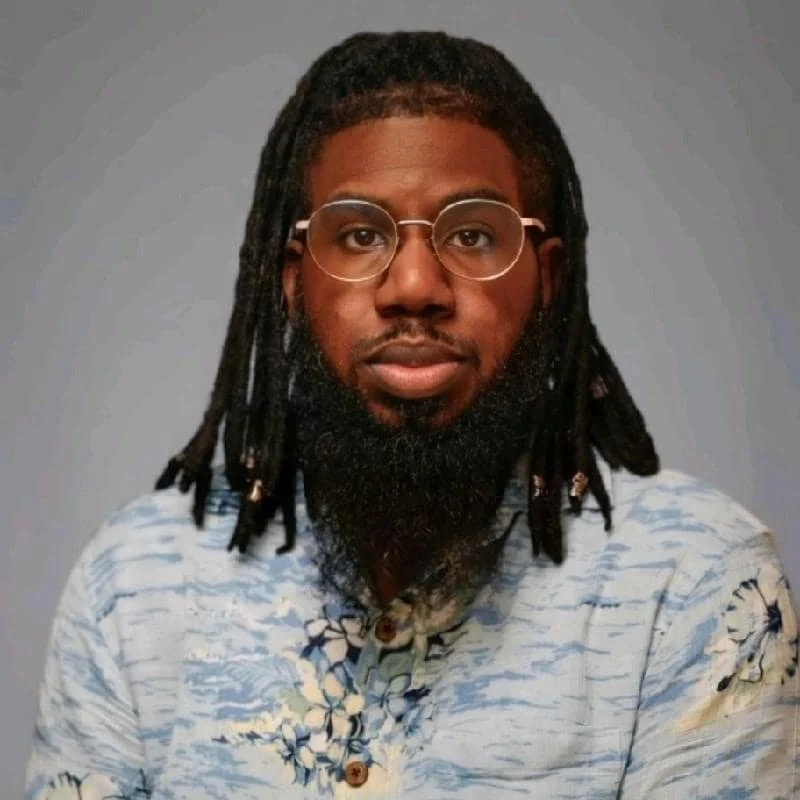
Learn more about Lord-Vincent’s work here: https://namastecollective.org/
“Growing up, I learned early that adults don't always realize how much young people see and understand.
I was parentified at a very young age. I heard conversations that probably weren't appropriate for me to hear. Adults sometimes operated from this idea that children should be seen and not heard, but we know things. We see things that adults think we don't see.
That was especially complicated for me as a Black boy.
I remember being seven years old while my parents were going through a divorce and being told, “You need to take care of your mama.” But I was seven. I didn't need to be treated like a young man responsible for taking care of someone else. I needed adults to take care of me.
There were also a lot of messages about what it meant to be a Black boy or a man. There was this expectation that you couldn't cry or show certain emotions. At the same time, I saw grown men cry when Tupac and Biggie died. Those contradictions stayed with me.
As I got older, I also learned how carefully Black men sometimes have to navigate emotions. There is the stereotype of the “angry Black man.” You learn that you can't necessarily be angry in certain spaces without people seeing you differently. You can enter a space and everybody loves you. People want to mentor you, show you around, take you to lunch. But once you know more, set boundaries, or get upset about something, suddenly you can be seen as a threat.
Some of those same dynamics showed up during my time in foster care.
I was moved around Oklahoma and couldn't build friendships or have many of the normal experiences other young people had. When I spoke up about where I wanted to live or questioned what was happening, I could be considered disrespectful, defiant, or not a team player.
What I didn't understand then was that sometimes the adults making those decisions had information I didn't have.
I eventually became a caseworker myself. Once I was on the other side, I could see the bureaucracy and some of the limitations caseworkers were dealing with. There were times when a young person couldn't stay in a particular community because being there could put them back near someone who had harmed them.
When I had to explain something like that to a young person, I would actually have the conversation.
I could say, “I would love for you to live in the same community as your grandma, but because of what happened, keeping you there might mean you run into her. We can't do that, so we have to look somewhere else.”
And sometimes the young person would say, “Okay. That makes sense.”
That's when I would think: Why didn't someone just have that conversation with me?
I didn't necessarily need every decision to go my way. I needed someone to explain what was happening.
There were adults who did that differently.
I had a judge who would pull me into his chambers and actually talk to me. Instead of only accepting that I was being rude or difficult, he would ask me to tell him more. We would sit there, eat candy, and talk. Then he would make decisions based on what he learned, including decisions about my school.
Teachers did that for me too. There were teachers who saw something in me and essentially said, “This is a smart kid. We can't lose this.”
When I think about the programs that helped me, though, I have a harder time naming them. A lot of the support I remember came from individual people.
Sometimes one of those people would eventually tell me, “Have you heard about this program?”
And I hadn't.
By the time I learned about some opportunities, I wasn't in the right age range anymore or didn't qualify for the services. It felt like I kept meeting random people who happened to help me along the way.
Even some of the independent-living support didn't always match where I actually was.
I knew how to cook. I knew how to clean. But I was 16 and couldn't get foster parents to teach me how to drive. Then I could go to a workshop where someone might offer a gas card as an incentive.
What was I supposed to do with a gas card when I didn't even have my learner's permit?
There were ordinary high-school experiences I had to figure out for myself too. I bought my own letterman's jacket. I bought my own class ring. Those things might seem small, but they were part of getting to experience high school like other young people.
Through all of it, I've learned that I'm resilient.
When I go to retreats where people are asked to bring an object that represents them, I bring a hair tie.
I had one hair tie that stayed with me through an entire year when life was really lifing. You could see the stretchy material coming out of it. I kept thinking it was finally going to break.
But it didn't.
It stretched way beyond what I thought it could handle, and somehow it stayed together.
That's how I see myself.
I've been stretched. I've had moments when I thought I couldn't keep going. Even now, there are days when I joke that I'm ready to throw Namaste Collective in the trash.
But I bounce back.
And when I think about young people who are navigating systems today, I think we need more than an invitation into the room.
We need a good seat at the table.
Not a wobbly seat. Not a seat in the corner. Not a situation where you can say, “Well, there was a young person in the room,” but nobody actually listened to what they said.
I'd rather be marginalized than tokenized.
If you're going to invite us into these spaces, what we say should matter. Our ideas should make it into the bill, the law, the policy, or whatever is being created. Even if you only use one sentence of what a young person suggested, there should be some way to see that they were actually part of it.
Don't just put us in the room.
Give us a good seat."
